Quick Update:
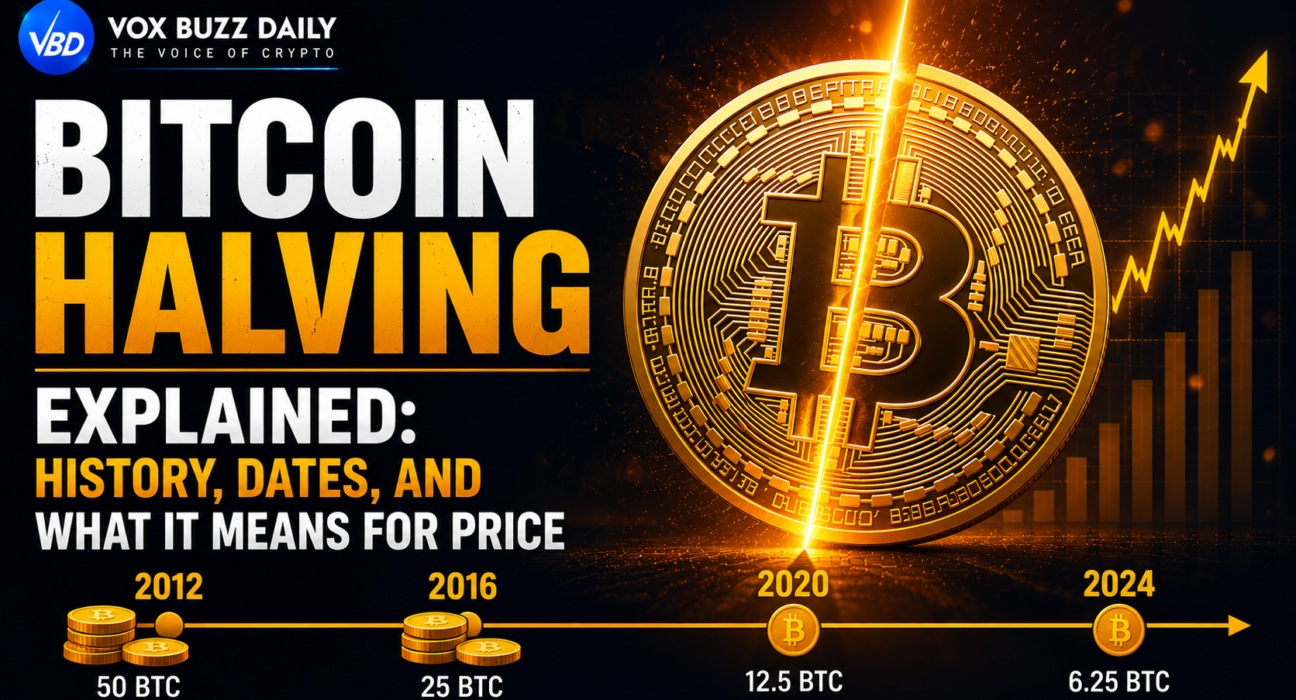
The Bitcoin halving is a pre-programmed event that cuts the reward paid to Bitcoin miners in half approximately every four years reducing the rate at which new Bitcoin enters circulation. There have been 4 halvings so far: in 2012, 2016, 2020, and April 2024. The most recent halving (April 20, 2024) cut block rewards from 6.25 BTC to 3.125 BTC. Each halving has historically been followed by a major Bitcoin bull run. The next halving is expected in April 2028, when rewards will drop to 1.5625 BTC. As of May 2026, only ~970,000 BTC remain to be mined out of 21 million total.
What is the Bitcoin Halving?
The Bitcoin halving – sometimes called “the halvening” — is one of the most important and predictable events in all of finance. It is a moment coded directly into Bitcoin’s software where the reward that miners earn for processing transactions is cut exactly in half.
It happens automatically, without anyone’s approval or decision. No government, no CEO, no committee votes on it. It is simply written into Bitcoin’s code by its creator Satoshi Nakamoto — and it executes exactly as programmed every 210,000 blocks.
In simple terms: the halving is Bitcoin’s built-in mechanism to control inflation and protect scarcity.
Think of it like this. Imagine a gold mine that produces 900 tonnes of gold per year. Then suddenly — at a pre-announced date — the mine can only produce 450 tonnes per year. Then 225 tonnes. Then 112 tonnes. As production keeps falling while demand grows, the existing gold becomes more and more valuable. Bitcoin works the same way, except the schedule is fixed, public, and immutable.
Before the first halving in 2012, Bitcoin miners earned 50 BTC per block. Today, after four halvings, miners earn just 3.125 BTC per block. After the 2028 halving, they will earn 1.5625 BTC per block. The reward will keep halving approximately every four years until the last fraction of Bitcoin is mined around the year 2140.
Why Does the Bitcoin Halving Exist?
Satoshi Nakamoto designed the halving to solve two fundamental problems with traditional money:
Problem 1 — Uncontrolled Inflation
Central banks can print unlimited amounts of fiat currency — dollars, rupees, euros — whenever they choose. This dilutes the purchasing power of existing money over time. Bitcoin’s halving does the opposite: it progressively reduces the rate at which new Bitcoin is created, making it increasingly scarce and deflationary.
Problem 2 — Rewarding Early Adopters While Maintaining Long-Term Security
Bitcoin needed to incentivise miners (who secure the network) in its early years when the network had little value. The large early rewards (50 BTC per block) attracted miners when Bitcoin was worth pennies. As Bitcoin became more valuable, the halving gradually reduced these rewards — because even a smaller BTC reward is worth more in dollar terms if Bitcoin’s price has risen sufficiently.
The result: Bitcoin has a fixed, predictable, and transparent monetary policy that no person, government, or institution can change. Unlike every fiat currency ever created, the total supply of Bitcoin is capped at exactly 21 million coins — and the halving is the mechanism that enforces this cap over time.
How Does the Bitcoin Halving Work?
Step-by-Step: The Halving Mechanism
Step 1 — Miners Process Transactions Bitcoin miners are computers (or networks of computers) that process and verify Bitcoin transactions. They group transactions into “blocks” and add them to the blockchain — Bitcoin’s permanent public ledger.
Step 2 — Miners Earn Block Rewards Every time a miner successfully adds a block to the blockchain, they earn a reward in newly created Bitcoin. This reward is how new Bitcoin enters circulation. It is also the primary incentive for miners to keep the network running and secure.
Step 3 — Every 210,000 Blocks, the Reward Halves Bitcoin’s code automatically triggers a halving event every 210,000 blocks. Since each block takes approximately 10 minutes to mine, 210,000 blocks takes roughly 4 years (210,000 × 10 minutes = 1,458 days ≈ 4 years).
Step 4 — New Bitcoin Supply Drops After the halving, miners earn half as much Bitcoin per block. This immediately cuts the rate of new Bitcoin entering circulation by 50% — overnight, with zero warning needed because the date is predictable years in advance.
Step 5 — Scarcity Increases With less new Bitcoin being produced every day, existing Bitcoin becomes scarcer. If demand remains constant or grows while supply falls, basic economics suggests price should rise over time.
How Many Bitcoin Are Created Each Day?
| Period | Block Reward | Daily BTC Created |
|---|---|---|
| 2009–2012 | 50 BTC | ~7,200 BTC/day |
| 2012–2016 | 25 BTC | ~3,600 BTC/day |
| 2016–2020 | 12.5 BTC | ~1,800 BTC/day |
| 2020–2024 | 6.25 BTC | ~900 BTC/day |
| 2024–2028 (now) | 3.125 BTC | ~450 BTC/day |
| 2028–2032 | 1.5625 BTC | ~225 BTC/day |
As of May 2026, only 450 BTC per day enter circulation — compared to 7,200 BTC per day when Bitcoin launched. After the 2028 halving, this will drop further to just 225 BTC per day.
Complete Bitcoin Halving History
Here is every Bitcoin halving event, at a glance:
| Halving | Date | Block # | Reward Before | Reward After | BTC Price at Halving | Peak Price After | Peak Gain |
|---|---|---|---|---|---|---|---|
| 1st | Nov 28, 2012 | 210,000 | 50 BTC | 25 BTC | ~$12 | ~$1,150 (Dec 2013) | +8,858% |
| 2nd | Jul 9, 2016 | 420,000 | 25 BTC | 12.5 BTC | ~$650 | ~$20,000 (Dec 2017) | +2,977% |
| 3rd | May 11, 2020 | 630,000 | 12.5 BTC | 6.25 BTC | ~$8,700 | ~$69,000 (Nov 2021) | +693% |
| 4th | Apr 20, 2024 | 840,000 | 6.25 BTC | 3.125 BTC | ~$63,971 | ~$126,198 (Oct 2025) | +97% |
| 5th | ~Apr 2028 | 1,050,000 | 3.125 BTC | 1.5625 BTC | — | — | — |
The pattern is unmistakeable: every halving has been followed by a new all-time high. The percentage gains diminish as Bitcoin’s market cap grows (you cannot do 8,000% from a $1 trillion asset), but the directional outcome has been consistent across all four cycles.
The 2012 Halving — Bitcoin’s First
Date: November 28, 2012 Block: 210,000 Reward: 50 BTC → 25 BTC Price at halving: ~$12
Bitcoin’s first halving happened when almost nobody outside the cypherpunk community knew it existed. The price was just $12. Infrastructure was minimal — exchanges were fragile, wallets were primitive, and the idea of institutional investors touching Bitcoin was science fiction.
Yet the halving worked exactly as designed. A week before the first halving, Bitcoin’s market cap was only $123.3 million. A day after the halving it went up to $130.3 million, and within three months by the end of February 2013, Bitcoin’s market cap was $335.2 million.
By December 2013 — just over a year after the halving — Bitcoin had surged to nearly $1,150, an extraordinary gain of over 8,858% from the halving price. The first halving proved the core thesis: reduce supply, maintain demand, price rises.
Key takeaway: The 2012 cycle reflected a tiny starting base and early discovery phase. The returns were explosive because Bitcoin was starting from almost zero.
The 2016 Halving — Mainstream Awakening
Date: July 9, 2016 Block: 420,000 Reward: 25 BTC → 12.5 BTC Price at halving: ~$650
By 2016 Bitcoin had survived its first major crash (from $1,150 in 2013 to ~$200 in 2015) and was rebuilding. The halving arrived as retail awareness was expanding — this was the cycle that introduced millions of new investors to crypto.
In anticipation of the halving, Bitcoin’s market cap rose to a yearly high of $11.9 billion a month before. Three months after the halving, the market cap actually dropped to $9.6 billion — then after a market correction, it took until January 2017 for a new all-time high to be reached.
The important lesson from 2016: the halving did not immediately pump the price. There was a multi-month consolidation period before the real bull run began. By December 2017, Bitcoin peaked at nearly $20,000 — a 2,977% gain from the halving price.
Key takeaway: The 2016 halving introduced the pattern that would repeat: pre-halving accumulation, post-halving consolidation, then a delayed but massive bull run 12–18 months later.
The 2020 Halving — Institutional Era Begins
Date: May 11, 2020 Block: 630,000 Reward: 12.5 BTC → 6.25 BTC Price at halving: ~$8,700
The 2020 halving arrived in the middle of a global pandemic. Governments were printing money at unprecedented scale, and Bitcoin’s “digital gold” and inflation hedge narrative resonated with a new class of investor: institutions.
The 2020 halving saw Bitcoin’s price climb from approximately $8,000 to an all-time high of around $64,000 within a year before entering a correction phase. By November 2021, Bitcoin reached a then-ATH of $69,000 — a gain of ~693% from the halving price.
What made 2020 different was the demand side: MicroStrategy, Tesla, Square, and PayPal all announced Bitcoin purchases in 2020–2021. This was the first halving cycle with meaningful institutional participation — and it amplified the post-halving supply shock dramatically.
Key takeaway: The 2020 cycle proved that macroeconomic conditions (quantitative easing, inflation fears) can dramatically amplify the halving’s natural supply-shock effect.
The 2024 Halving — The ETF Cycle
Date: April 20, 2024 Block: 840,000 Reward: 6.25 BTC → 3.125 BTC Price at halving: ~$63,971
The 2024 halving was unlike any before it — because it arrived alongside the most significant new financial product in Bitcoin’s history: US spot Bitcoin ETFs, approved by the SEC on January 11, 2024, just three months before the halving.
The 2024 halving played out alongside the launch of US spot Bitcoin ETFs, which is the variable that broke the historical cycle template. The mechanical halving effect remained, but the demand side simply changed.
For the first time in history, a massive, regulated institutional demand machine (ETFs accumulating 600,590+ BTC in net inflows) was absorbing the newly scarce supply in real time. ETFs were purchasing far more Bitcoin daily than miners were producing. The result:
- Bitcoin traded at ~$63,971 at halving — already near its previous ATH
- It reached a new all-time high of $126,198 on October 6, 2025 — just 18 months after the halving
- The peak gain of ~97% was the smallest in halving history in percentage terms — but also came from the highest starting base
One year after the 2024 halving, Bitcoin was trading between $80,000 and $90,000, making this the weakest post-halving performance on record in terms of percentage growth. After previous halvings, Bitcoin typically rallied strongly within 12 months: following the 2012 halving, BTC’s price saw an explosive 7,000% surge, while the 2016 and 2020 cycles posted gains of 291% and 541% respectively.
Key takeaway: The 2024 cycle was different because ETF demand replaced retail FOMO as the primary buying force — creating a more institutional, less explosive, but more structurally supported price trajectory. As of May 2026, Bitcoin sits at $74,000–$81,000, in a post-ATH consolidation phase consistent with previous mid-cycle patterns.
How the Halving Affects Bitcoin’s Price
The halving affects Bitcoin’s price through three distinct mechanisms:
1. The Supply Shock
Immediately after a halving, the daily flow of new Bitcoin into the market is cut in half. If demand holds constant and supply drops, prices should rise — this is basic economics. The halving reduces the rate of new Bitcoin entering the market. If demand stays constant or grows, lower supply growth puts upward pressure on price.
2. The Pre-Halving Accumulation
Markets are forward-looking. Sophisticated investors begin accumulating Bitcoin months before the halving in anticipation of the post-halving supply drop. A few patterns stand out from historical halving data: prices often rise in pre-halving accumulation phases as informed investors position ahead of the event.
3. The Delayed Price Response
The price impact of each halving has never been immediate. The pattern across all four halvings shows a consistent lag between the supply reduction and the price response. Prices didn’t peak immediately after each halving — the bigger moves came 6 to 18 months later.
This lag exists because:
- Miners initially sell more BTC to cover operating costs at the reduced reward rate
- It takes time for reduced supply to outstrip existing market liquidity
- Retail and institutional investors enter gradually, not all at once
Price Pattern Across All Four Cycles
| Phase | What Happens | Timeframe |
|---|---|---|
| Pre-halving | Accumulation, rising prices | 6–12 months before |
| Halving day | Often a “sell the news” dip | Day of / week after |
| Post-halving consolidation | Sideways or slight correction | 1–6 months after |
| Bull run | Major price appreciation | 6–18 months after |
| Blow-off top | Peak price, then sharp correction | 12–24 months after |
| Bear market | 70–80% correction from ATH | 1–2 years after peak |
How the 2024 Halving Was Different From All Others
The 2024 cycle broke several historical patterns — and understanding why matters for how you interpret the 2028 cycle:
1. ETFs Changed the Demand Equation Previous halvings had retail investors as the primary new demand source. In 2024, regulated ETFs brought institutional capital that dwarfed retail flows. This made the price action smoother, less explosive, but more structurally supported.
2. Bitcoin Was Already Near Its ATH at the Halving In 2012, 2016, and 2020, Bitcoin was well below its previous ATH at the halving date. In 2024, Bitcoin was trading at ~$63,971 — just below its then-ATH of $73,700. The pre-halving rally had already priced in much of the supply shock.
3. Macro Uncertainty Was at Record Highs The lackluster post-halving performance coincided with increased macroeconomic uncertainty. During the six months following the halving, the Economic Policy Uncertainty Index averaged 317, compared to 107 in 2012, 109 in 2016, and 186 in 2020 over the same post-halving periods. Trade tensions, geopolitical shocks, and Fed rate uncertainty all dampened the typical post-halving enthusiasm.
4. Bitcoin’s Volatility Has Structurally Declined Bitcoin’s 60-day price volatility has dropped sharply — from over 200% in 2012 to barely 50% today. As Bitcoin matures, it is now more likely to deliver stable, though potentially more subdued, returns compared to earlier cycles.
What this means for 2026: The 2024 halving delivered its ATH on schedule (October 2025 at $126,198). The current consolidation at $74,000–$81,000 is consistent with Bitcoin’s historical post-ATH correction phase. Whether a second leg higher materialises in H2 2026 or early 2027 depends primarily on CLARITY Act passage, ETF inflows, and Warsh’s monetary policy — not the halving itself, which has already played out.
The Next Bitcoin Halving — 2028
The fifth Bitcoin halving is the next major scheduled event on Bitcoin’s monetary calendar.
| Detail | Value |
|---|---|
| Expected Date | ~April 19, 2028 |
| Target Block | 1,050,000 |
| Current Reward | 3.125 BTC per block |
| Reward After 2028 Halving | 1.5625 BTC per block |
| Days Until 2028 Halving | ~695 days from May 2026 |
| Daily BTC After Halving | ~225 BTC/day (down from 450) |
| Bitcoin Inflation Rate After | ~0.4% annually |
The next halving is estimated to occur on approximately April 19, 2028, at block 1,050,000. At that point, the block reward will drop from 3.125 BTC to 1.5625 BTC.
What Could the 2028 Halving Mean for Price?
By 2028, the structural backdrop will be significantly different from any previous cycle:
- ETF infrastructure is mature — billions in daily ETF flows will be the norm, not the exception
- Sovereign Bitcoin Reserves — the US Strategic Bitcoin Reserve and potentially other nation-states will be competing for supply
- Only 225 BTC per day entering circulation — one-third the current rate
- Corporate Bitcoin treasuries (MicroStrategy has 580,000+ BTC, many others are following) will absorb a growing share of supply
If historical post-halving patterns hold — and the demand environment is stronger than in 2024 — the 2028 halving could be the most supply-constrained event in Bitcoin’s history. Ark Invest projects Bitcoin could reach $300,000–$1.5 million by 2030, with the 2028 halving as a central driver.
2028 Halving: Pre-Game Checklist for Investors
- The ideal accumulation window (based on historical patterns) is approximately 12–18 months before the halving — meaning mid-2026 to late-2027
- The pre-halving period historically sees Bitcoin outperform even as the broader market is uncertain
- Dollar-cost averaging (DCA) starting now and continuing through 2027 is how most long-term investors plan to position for the 2028 cycle
What Happens When All 21 Million Bitcoin Are Mined?
This is one of the most fascinating questions in all of crypto — and the answer affects Bitcoin’s long-term security model.
When does the last Bitcoin get mined? The last Bitcoin is projected to be mined around the year 2140 — over 114 years from now. This is because the halving keeps reducing rewards exponentially; the final fractions of Bitcoin will take decades to mine.
After 2140 — Miner Incentives Once all 21 million Bitcoin are mined, miners will no longer earn new Bitcoin as a block reward. Their only income will come from transaction fees — the small amounts users pay to have their transactions included in the next block.
This raises important long-term questions:
- Will transaction fees be sufficient to incentivise miners to keep securing the network?
- Will Bitcoin’s block size or fee market need to evolve?
- Will the Lightning Network (Bitcoin’s second-layer payment system) change the fee equation?
These are open questions that the Bitcoin developer community actively debates. Most economists and Bitcoin researchers believe transaction fees will scale sufficiently to maintain network security — but this will only be tested over the coming century as block rewards gradually approach zero.
Bitcoin’s inflation rate over time:
| Year / Period | Annual Inflation Rate |
|---|---|
| 2009–2012 | ~100% (early, lots of new BTC) |
| 2020–2024 | ~1.7% |
| 2024–2028 (now) | ~0.83% |
| 2028–2032 | ~0.4% |
| Post-2032 | Declining toward 0% |
| 2140+ | 0% (no new Bitcoin) |
For context: gold’s annual supply growth is approximately 1.5–2% per year — Bitcoin’s inflation rate in the current halving epoch (0.83%) is already lower than gold’s, reinforcing the “digital gold” narrative.
How to Prepare for the Bitcoin Halving as an Investor
Whether you are preparing for the aftermath of the 2024 halving (now in consolidation) or positioning for the 2028 halving cycle, here is how experienced investors approach it:
For the 2024 Post-Halving Phase (Now — 2026/2027)
1. Dollar-Cost Average (DCA) Rather than trying to time the exact bottom, invest a fixed INR amount in Bitcoin weekly or monthly. History shows the best DCA windows follow ATH corrections — and Bitcoin is currently ~38–40% below its October 2025 ATH of $126,198.
2. Watch the CLARITY Act The single biggest near-term price catalyst is not halving-related — it is whether the US CLARITY Act passes the Senate in 2026. Passage could trigger $15 billion in additional ETF inflows and push BTC toward $143,000 (Citi target).
3. Hold Through Volatility Every post-halving cycle has included a significant mid-cycle correction. The 2021 cycle saw Bitcoin fall from $65,000 to $28,000 before recovering to its $69,000 ATH. Investors who panic-sold the correction missed the ATH. Conviction in the long-term thesis matters more than perfect timing.
For the 2028 Halving Cycle (2026–2028)
1. Accumulate in the Pre-Halving Window Historical data shows Bitcoin typically outperforms in the 12–18 months before a halving as anticipation builds. The window for 2028 pre-halving accumulation is approximately October 2026 – October 2027.
2. Secure Your Holdings As Bitcoin appreciates, the importance of secure storage grows. Use a hardware wallet (Ledger or Trezor) for any significant holdings. Do not leave large amounts on exchanges.
3. Track Indian Tax Obligations All Bitcoin gains in India are taxed at 30% flat + 4% cess, with 1% TDS on every transaction. Keep detailed records of every purchase with dates and prices for accurate ITR filing. Plan your tax liability before major selling events.
4. Do Not Over-Leverage The excitement around halving cycles attracts leveraged speculation. Historically, leverage in crypto leads to liquidations during the inevitable mid-cycle corrections. Spot holdings — Bitcoin you actually own — outperform leveraged positions over full cycles for most retail investors.
Frequently Asked Questions
1. What is the Bitcoin halving in simple terms?
The Bitcoin halving is a pre-programmed event that cuts the reward Bitcoin miners receive in half approximately every four years. It reduces the rate at which new Bitcoin is created, making Bitcoin scarcer over time. Because only 21 million Bitcoin will ever exist, the halving is the mechanism that enforces this scarcity — similar to how a gold mine gradually produces less gold as it is depleted.
2. When is the next Bitcoin halving?
The next Bitcoin halving is expected in approximately April 2028, at block 1,050,000. At that point, the block reward will drop from 3.125 BTC to 1.5625 BTC per block, reducing daily new Bitcoin supply from ~450 BTC to ~225 BTC. The exact date depends on how fast the Bitcoin network mines blocks — it can shift slightly earlier or later.
3. How many Bitcoin halvings have there been?
There have been four Bitcoin halvings: the first on November 28, 2012 (50 BTC → 25 BTC), the second on July 9, 2016 (25 BTC → 12.5 BTC), the third on May 11, 2020 (12.5 BTC → 6.25 BTC), and the fourth on April 20, 2024 (6.25 BTC → 3.125 BTC). The fifth halving is expected around April 2028.
4. Does the Bitcoin halving always increase price?
Historically, every Bitcoin halving has eventually been followed by a new all-time high — but never immediately. The price response typically arrives 6–18 months after the halving, and the percentage gains diminish each cycle as Bitcoin’s market cap grows. The 2024 halving was followed by an ATH of $126,198 in October 2025. However, past performance does not guarantee future results.
5. What happened to Bitcoin’s price after the 2024 halving?
Bitcoin traded at approximately $63,971 at the April 2024 halving. It went on to reach a new all-time high of $126,198 on October 6, 2025 — a gain of approximately 97% from the halving price. As of May 2026, Bitcoin has corrected to approximately $74,000–$81,000, roughly 38–40% below the ATH, in a post-peak consolidation phase consistent with historical Bitcoin cycle patterns.
6. Why does the Bitcoin halving happen every 4 years?
The four-year interval is determined by Bitcoin’s block production schedule. Bitcoin mines approximately one block every 10 minutes. A halving occurs every 210,000 blocks — which at 10 minutes per block equals roughly 1,458 days or about four years. The four-year cycle is an approximation rather than a fixed calendar date.
7. What will happen to Bitcoin miners after the 2028 halving?
After the 2028 halving, miners will earn 1.5625 BTC per block instead of 3.125 BTC. This will squeeze miners with higher electricity costs, potentially forcing less efficient operations to shut down. Network hashrate may temporarily dip before recovering. Long-term, miners will increasingly rely on transaction fees (in addition to block rewards) as the primary income source as rewards continue halving every four years.
8. How many Bitcoin are left to mine?
As of May 2026, approximately 20.03 million Bitcoin have been mined out of the maximum 21 million total supply. Roughly 970,000 BTC — about 4.6% of total supply — remain to be mined. Due to the exponentially declining reward schedule from each halving, the final Bitcoin will not be mined until approximately the year 2140.
9. What is the Bitcoin halving’s impact on Indian investors?
For Indian Bitcoin investors, the halving is significant as a long-term price catalyst — but remember that all profits are taxed at India’s flat 30% rate plus 4% cess. A 97% gain from the 2024 halving cycle means paying 31.2% on those profits. Plan your tax obligations before major selling events. Use the pre-halving accumulation window (historically the 12–18 months before each halving) as a DCA opportunity.
10. Is the four-year Bitcoin cycle broken after 2024?
Some analysts argue the ETF approval in January 2024 has permanently altered Bitcoin’s cycle dynamics — meaning the old four-year pattern may no longer apply in its classic form. Others argue the cycle is intact but has matured: gains are smaller in percentage terms but the direction remains consistent. The 2024 cycle delivered an ATH on roughly the expected post-halving schedule, suggesting the cycle is evolving rather than broken.
Conclusion
The Bitcoin halving is not just a technical event — it is Bitcoin’s heartbeat. It is the scheduled, predictable, and immutable mechanism by which Bitcoin enforces its 21 million supply cap and transitions from an inflationary to a deflationary monetary asset, cycle by cycle.
Four halvings have now occurred. Each one has followed the same broad arc: reduced supply → consolidation → delayed bull run → new all-time high → correction. The details vary — the 2024 cycle was notably different due to ETFs and macro headwinds — but the structural logic is intact.
As of May 2026, we are in the post-2024 halving consolidation phase. Bitcoin sits at approximately $74,000–$81,000, roughly 40% below its October 2025 ATH of $126,198. The next halving is ~695 days away, expected in April 2028. The pre-2028 halving accumulation window — historically one of Bitcoin’s best long-term entry periods — begins approximately in late 2026.
Whether you are a complete beginner learning about Bitcoin for the first time or an experienced investor planning your 2028 cycle strategy, understanding the halving is understanding Bitcoin’s most powerful fundamental driver.
At Vox Buzz Daily (VBD), we track every Bitcoin halving update, miner data, ETF flow, and price milestone in real time. Follow us on Twitter (@voxbuzzdaily), Instagram, and LinkedIn for daily coverage.