Quick Updates:
The Cockroach Janta Party is an Indian satirical political movement founded on May 16, 2026 by Abhijeet Dipke, a 30-year-old Boston University public relations graduate from Aurangabad, Maharashtra. It was born in direct response to remarks made by Chief Justice Surya Kant on May 15, 2026, in which he compared unemployed youth to cockroaches and parasites of society. Within 78 hours the Instagram account crossed 3 million followers. Within five days it crossed 10 million, overtaking the BJP’s official handle. As of May 22, 2026, the account had over 20 million followers and 350,000 sign-ups. The government blocked the movement’s X account, its website, and a backup X account within 10 days. Dipke moved the Delhi High Court on May 26 to challenge the ban. An anonymous developer separately launched the CJP meme coin on Solana’s Pump.fun, which surged over 400% in 24 hours with no official connection to the movement.The Spark: What Chief Justice Surya Kant Actually Said
Every movement starts with a moment. For the Cockroach Janta Party, that moment happened inside a Supreme Court of India hearing room on the afternoon of May 15, 2026.
Chief Justice Surya Kant was presiding over a case concerning fake professional credentials when he made remarks that quickly ricocheted across Indian social media. Surya Kant said during an open court hearing that parasites were attacking the system, and equated youngsters who do not get any employment and do not have any place in a profession to cockroaches.
The full quote as widely reported was: “There are youngsters like cockroaches, who don’t get any employment or have any place in the profession. They enter media, social media, RTI activism, and other spaces and proceed to attack everyone.”
The Chief Justice later said his remarks targeted people using fake degrees, not India’s youth broadly. But that clarification arrived after the damage was done. On Indian social media, the quote had already been extracted from its context and was circulating as a raw, unqualified statement comparing unemployed young Indians to insects.
The timing could not have been more combustible. India’s youth unemployment figures give full context to why the remark hit so hard. The jobless rate for those aged 15 to 29 sits at 9.9 percent. In urban areas it rises to 13.6 percent. Graduate unemployment among 15 to 25-year-olds sits at nearly 40 percent according to the 2026 Azim Premji University report. A Deloitte survey found that 54 percent of Indian Gen Z had postponed buying homes due to financial stress. AI was cutting entry-level IT jobs. The rupee was falling. Fuel prices were spiking after the Iran conflict. For millions of young Indians who had done everything right, earned their degrees, applied for jobs, and still could not find work, being compared to cockroaches by the country’s highest judge was not an abstract judicial metaphor. It was an insult.
Within hours of the remarks spreading online, Indian social media was flooding with outrage, memes, and a single question that one person was about to answer in a way nobody expected.
Who is Abhijeet Dipke? The Man Behind the Movement
The face and founder of the Cockroach Janta Party is Abhijeet Dipke, a 30-year-old political communications strategist originally from Aurangabad in Maharashtra.
At the time of the party’s founding, he was finishing his master’s degree in public relations at Boston University in the United States. His background in digital media strategy and political communication had been shaped by a previous stint working with the Aam Aadmi Party’s social media team between 2020 and 2022, contributing to meme-driven campaign content during the Delhi Assembly elections. That experience clearly shaped his instincts around viral communication and internet-first political messaging.
Abhijeet Dipke has been open about the fact that the Cockroach Janta Party was born from pure impulse rather than any strategic plan. The moment he read about the Chief Justice’s remarks, the idea simply arrived.
As Al Jazeera described the moment: “Dipke barely slept in the last 72 hours, fielding waves of messages on social media after a casual joke took an unexpected turn.” The casual joke was a single post on X on the evening of May 15, 2026, where Dipke posted: “What if all cockroaches come together?”
That question became a movement.
Dipke has been careful throughout to define what kind of movement he wants the CJP to be. When journalists began drawing comparisons to the youth-led protests that toppled governments in Bangladesh in 2024 and contributed to political turbulence in Nepal, Dipke pushed back firmly. He insisted that such comparisons insult India’s Gen Z rather than compliment them. His argument was that Indian youth are deeply aware of their constitutional rights and fully capable of expressing dissent through peaceful, democratic, and legal channels.
He told the Associated Press: “Five years ago, nobody was ready to speak up against Modi or the government. The times are changing.”
He told another outlet: “The youth are really frustrated and the government is not acknowledging their concerns.”
May 16, 2026: The Cockroach Janta Party is Born
On May 16, 2026, Abhijeet Dipke launched:
- The website cockroachjantaparty.org
- An Instagram account for the Cockroach Janta Party
- An X account under the handle @CJP_2029
The name was a deliberate satirical reference to the ruling Bharatiya Janta Party (BJP). The “Janta” in both names means “people” in Hindi. The CJP’s name positioned itself as the party of the cockroaches, the people the Chief Justice had dismissed as unemployable parasites.
The branding was immediate and striking. The cockroach logo, rendered in clean graphic design, appeared on every platform simultaneously. The tone was self-deprecating and sharp: we are the cockroaches you looked down on, and now we are organising.
Dipke made clear from the beginning that the Cockroach Janta Party is not a registered political party and has no intention of contesting elections. It is a satirical movement. But satire in India in 2026 carries real political weight, and the speed of what happened next proved it.
The Viral Explosion: 20 Million Followers in Under a Week
What followed May 16 was a growth curve that even seasoned digital media professionals found difficult to explain fully.
Within 78 hours of launch, the Instagram account crossed 3 million followers.
Within five days, it surpassed 10 million followers, overtaking the official handle of the BJP, India’s ruling party with hundreds of millions of members.
As of May 22, 2026, the account displayed over 20 million followers.
Over 350,000 people signed up through a Google form linked from the account, with more than 70 percent of respondents aged 19 to 25.
The hashtag #MainBhiCockroach (meaning “I too am a cockroach”) went viral across Twitter and Instagram. Supporters across India filmed themselves wearing cockroach costumes and taking part in clean-up drives, planting trees, and participating in street demonstrations. In multiple cities, young people held up banners that said “We Are the Cockroaches You Created.”
AI-generated images were also used to promote the movement’s messaging and key issues. The movement became one of the fastest-growing political trends on Indian social media in recorded history, comparable in speed only to global events like the 2020 Black Lives Matter social media wave.
The movement struck a chord across India’s youth not only because of the cockroach insult but because the CJP gave a name, a logo, and a community to frustrations that had been accumulating for years without a unifying outlet.
As CBS News reported: “There is nothing satirical about it, it’s raising serious issues of the youth in a smart way,” one student from Delhi said. “Perhaps the reason why the government is unnerved by it.”
The Five-Point Manifesto: What CJP Actually Wants
Despite its satirical presentation, the Cockroach Janta Party published a substantive five-point manifesto addressing real policy demands. This is what separates CJP from a pure internet joke and gives it political weight beyond meme culture.
The five points of the CJP manifesto are:
1. Ban on Post-Retirement Rewards for Judges The CJP calls for a prohibition on retired judges being appointed to government positions, commissions, or tribunals after leaving the judiciary. The argument is that the prospect of post-retirement appointments creates a structural conflict of interest that compromises judicial independence.
2. Fifty Percent Reservation for Women in Parliament and Cabinet The CJP demands that at least 50 percent of seats in India’s Parliament and Cabinet be reserved for women, arguing that political representation must reflect population composition.
3. Protection of Voting Rights The manifesto calls for stronger legal protections for voter rights, electoral integrity, and the independence of the Election Commission of India.
4. An Independent Press The CJP demands structural protections for press freedom and independence from government ownership or influence, citing concerns about media concentration and editorial independence in India’s current media environment.
5. A 20-Year Ban on Politicians Switching Parties The manifesto calls for legislation preventing elected politicians from switching political parties for a 20-year period, targeting the practice of “party-hopping” that critics argue is often financially motivated and undermines electoral mandates.
Dipke described the manifesto’s purpose clearly: “This is something unprecedented that is happening. The plan is to change the political discourse and to make politicians more accountable.”
The specific demand for a ban on post-retirement judicial appointments is widely interpreted as a direct response to the Chief Justice’s cockroach remark. It places the institutional critique at the centre of the political agenda, not just the specific comment.
The Cockroach as a Symbol: Why It Works
The choice of the cockroach as a symbol is not accidental and deserves its own analysis, because it is precisely what made the movement culturally resonant rather than just politically angry.
The cockroach is perhaps the most universally recognised survivor in the natural world. It has existed for over 300 million years. It can survive radiation levels that would kill humans. It can live without food for a month, without water for a week, and without its head for several days. In popular culture, the cockroach is the creature that survives everything, including nuclear war.
By accepting the cockroach label and reclaiming it as an identity, the CJP movement performed a specific cultural manoeuvre: it turned the insult into a strength. The message was not “we are not cockroaches.” The message was “we are cockroaches, and cockroaches survive everything you throw at them.”
For a generation of Indian youth who have watched their degrees devalue, their job prospects narrow, their housing costs soar, and their political leaders dismiss their concerns, the cockroach survival narrative resonated at a level that polished political messaging could not reach. It was the right symbol at the right moment.
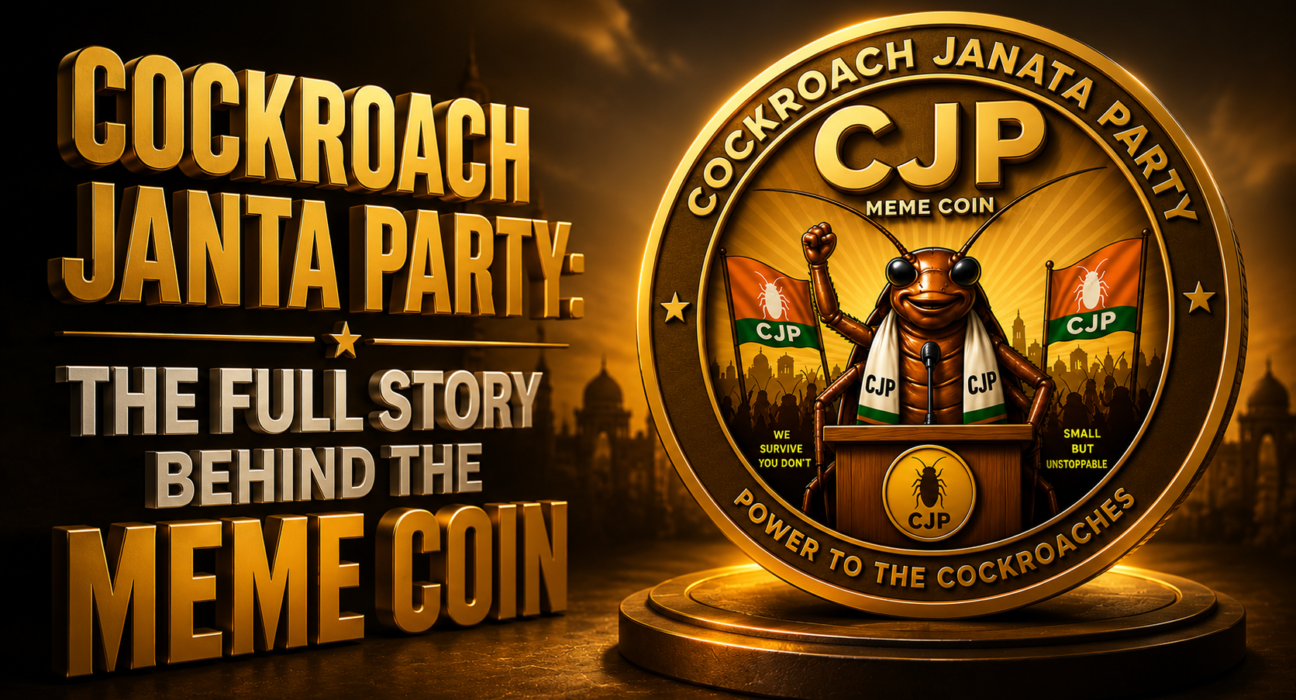
In crypto culture, this symbolism carried directly into the CJP meme coin’s identity. The cockroach token that survives market crashes, rug pulls, and government crackdowns is a narrative that writes itself in the meme coin ecosystem.
The Government Cracks Down: X Account Blocked, Website Taken Down
The government’s response to the CJP’s viral rise was rapid and escalating.
May 21, 2026: The Ministry of Electronics and Information Technology (MeitY) directed X to withhold the @CJP_2029 account under Section 69A of the Information Technology Act, 2000. The direction cited inputs from the Intelligence Bureau (IB) on national security grounds. A senior government official speaking anonymously told The Wire: “MeitY received an input from the IB to block the X account of Cockroach Janta Party, citing that it posed a threat to the sovereignty of India. In particular, the concern stemmed from the fact that the account’s content was gaining traction among young people.”
The blocking order remained confidential under Rule 16 of the IT Blocking Rules. No public order was issued explaining the specific grounds. The block was reportedly triggered when the CJP X account had around 90,000 followers.
Dipke’s response was characteristically defiant. He posted on X: “Within 4 days the account got banned because it got more than 200K following.” He immediately launched a backup account titled @Cockroachisback, which gained nearly 200,000 followers before MeitY took that one down too on May 23, 2026.
May 23, 2026: The official CJP website was also taken down. This occurred after the website had launched an online petition demanding the resignation of Education Minister Dharmendra Pradhan following the NEET 2026 paper leak, a major examination controversy that had caused enormous public anger among Indian students.
May 24, 2026: Abhijeet Dipke announced that the Cockroach Janta Party’s Instagram page and his personal Instagram account had been hacked, temporarily disrupting the movement’s presence on the platform. He alleged the hacking was coordinated.
Throughout this period, scammers also exploited the movement’s viral reach through phishing links and impersonation accounts, adding further confusion and risk for the movement’s followers.
Dipke Fights Back: Delhi High Court Petition
Rather than retreating, Abhijeet Dipke escalated.
May 26, 2026: Dipke moved the Delhi High Court, challenging the government’s decision to block the CJP’s X account under Section 69A of the Information Technology Act, 2000. The petition was filed through advocate Nakul Gandhi, contesting the May 21 MeitY directive.
The legal argument rests on several grounds: that Section 69A blocking orders must have a public-facing justification to satisfy constitutional standards of transparency, that the suppression of a satirical political movement on national security grounds sets a dangerous precedent for free expression, and that the CJP’s content does not meet the legal threshold for blocking under the IT Act.
Congress MP Shashi Tharoor publicly supported Dipke’s legal challenge, writing on X: “I’m incredibly intrigued by the rise of #CockroachJantaParty. I understand the frustrations of the youth and see why they are resonating with it. This is precisely why the account being withheld on X is disastrous and deeply unwise.”
The Delhi HC case is ongoing as of May 28, 2026. Its outcome will significantly affect the CJP movement’s ability to operate on X in India and may set a precedent for how satirical political movements are treated under Indian IT law going forward.
The Death Threats and Personal Cost
The price Abhijeet Dipke has personally paid for founding the movement deserves attention.
May 22, 2026: Dipke publicly stated that he had received death threats via WhatsApp from anonymous numbers, and that his family in India was in danger. He disclosed this through social media posts that were widely shared and amplified by opposition politicians and journalists.
On May 24, 2026, Dipke said that both his personal Instagram account and the CJP party Instagram page had been hacked, temporarily removing the movement from its primary social media platform at a critical moment of growth.
The combination of government account blocking, website takedowns, personal account hacking, and death threats paints a picture of the personal cost of founding a viral political movement in India in 2026. Dipke, a 30-year-old still finishing his master’s degree in Boston, found himself at the centre of a national political controversy that reached CNN, NBC News, CBS News, Al Jazeera, and the Associated Press within days of posting what he described as a casual joke.
His response has been to keep moving. The Delhi HC petition was filed four days after the death threats were disclosed. The movement’s Instagram account was restored and continued publishing content. The cockroach, true to its symbolism, proved difficult to exterminate.
Political Reactions: Who Supported and Who Attacked
The CJP movement attracted support and criticism from across India’s political spectrum, reflecting how broadly the movement’s themes resonated beyond any single party’s base.
Support:
Trinamool Congress: On May 25, 2026, Trinamool Congress leaders Mamata Banerjee and Abhishek Banerjee expressed public support for the movement. Party spokesperson Derek O’Brien called it “a reflection of youth concerns and online political dissent in India.” Trinamool MPs Mahua Moitra and Kirti Azad actively amplified CJP posts on social media.
Congress: Congress and Left-leaning social media handles circulated CJP memes and posts. Shashi Tharoor publicly opposed the X account blocking. Several Congress spokespersons described the movement’s popularity as evidence of “growing frustration among unemployed youth and dissatisfaction over inflation and economic conditions.”
Opposition broadly: Multiple opposition voices claimed the popularity of the campaign reflected genuine grassroots anger that the ruling party had failed to address through policy.
Criticism:
Ruling party supporters: Several BJP supporters and sympathetic commentators described the CJP as a political conspiracy against the ruling party, pointing to Dipke’s prior association with the Aam Aadmi Party as evidence of partisan intent.
Sceptics: Some commentators questioned the movement’s authenticity, arguing that the rapid follower growth was driven by social media amplification algorithms and outrage mechanics rather than genuine grassroots mobilisation. Critics pointed out that 20 million Instagram followers does not automatically translate to 20 million committed political participants.
Legal scholars: Some constitutional law experts raised concerns about the precedent set by blocking a satirical political movement’s X account under national security grounds, arguing that this stretched the threshold for Section 69A to an extent that endangered legitimate political satire.
How the CJP Crypto Token Emerged from the Movement
As the Cockroach Janta Party movement was reaching peak viral momentum between May 19 and 21, 2026, an anonymous developer on the Solana blockchain saw an opportunity.
On Pump.fun, the Solana-based no-code meme coin launchpad, the developer created a token called Cockroach Janta Party with the ticker $CJP. The process took under five minutes. The developer used the movement’s name, imagery, and cultural moment as branding for a speculative cryptocurrency token.
Within 24 hours of launch, the CJP token surged over 400 percent. Trading volume exceeded $473,000 in a single day. The market cap briefly touched $506,000 at its all-time high. The token graduated from Pump.fun’s bonding curve to PumpSwap on Solana, placing it among the top 0.7 to 0.8 percent of all Pump.fun launches by this metric.
Critically, none of this happened with the knowledge, approval, or involvement of Abhijeet Dipke or the official Cockroach Janta Party movement.
CJP Movement vs CJP Token: Why They Are Not the Same Thing
This distinction is the single most important thing for any Indian reader to understand before connecting their feelings about the Cockroach Janta Party movement to any financial decision about the CJP token.
Factor CJP Movement CJP Token Founded by Abhijeet Dipke, a named, identified individual Anonymous developer, identity unknown Official connection Dipke has not endorsed the token Token used movement branding without authorisation Purpose Satirical political movement with a five-point manifesto Speculative meme coin with no utility or roadmap Social media 20 million Instagram followers, official accounts No official social media linked to token Legal status Unregistered movement, currently fighting account blocks in Delhi HC Unaudited Pump.fun token with no legal framework Accountability Dipke is publicly identified, faces personal consequences Anonymous developer has no accountability What buying supports Nothing financially; following and engaging supports the movement Supports anonymous early token holders and developer Buying the CJP token does not support Abhijeet Dipke. It does not fund the Delhi HC legal challenge. It does not contribute to the Cockroach Janta Party’s five-point manifesto. It does not help the movement’s Instagram account or protect it from hacking.
The CJP movement and the CJP token are two entirely separate things that happen to share a name. The anonymous developer who launched the token understood that the cultural energy of the movement would attract buyers, and they were right. But that cultural energy flows from the movement to the token, not from the token back to the movement.
If you want to support the Cockroach Janta Party movement, follow the Instagram account, sign up through their official channels, share the manifesto, and engage with the Delhi HC petition story. Buying a meme coin from an anonymous developer does none of these things.
The Bigger Picture: India’s Gen Z Finds Its Voice
The Cockroach Janta Party story, taken as a whole, is bigger than a judge’s remark and bigger than a viral meme coin. It is a signal of something structural happening in Indian political culture in 2026.
India has the largest youth population of any country in the world. The generation that grew up with smartphones, social media, and the promise of a booming economy is now facing a labour market that cannot absorb them, a political establishment that dismisses their concerns, and a media environment they increasingly distrust. South Asia has seen a number of youth-led movements against anger over corruption and inequality, and the CJP sits within that regional context.
What is distinctive about the CJP is its method. It chose satire over anger, memes over marches, Instagram over street protests. This is not political disengagement. It is a generation that has learned the language of the digital age and is using it to speak in a register that reaches millions of peers instantly.
Whether the Cockroach Janta Party sustains its momentum and translates its 20 million followers into meaningful policy change remains to be seen. The Delhi HC petition is pending. The Instagram account continues publishing content. Abhijeet Dipke is still at Boston University, finishing his degree while simultaneously leading a national political movement from across the world.
What has already happened is significant enough. A 30-year-old student with a casual joke on X created a movement that within a week was covered by CNN, NBC News, CBS News, Al Jazeera, Britannica, Wikipedia, and the Associated Press. It overtook the BJP on Instagram. It forced the government to deploy Section 69A. It sparked a Delhi HC petition that may set a precedent for how political satire is regulated in India.
And in its wake, someone launched a meme coin that surged 400 percent in a day.
The cockroach, as always, proved harder to exterminate than expected.
Full Timeline of the Cockroach Janta Party
Date Event May 15, 2026 Chief Justice Surya Kant makes remarks comparing unemployed youth to cockroaches and parasites during a Supreme Court hearing on fake professional credentials May 15, 2026 (evening) Abhijeet Dipke posts on X: “What if all cockroaches come together?” May 16, 2026 Dipke launches cockroachjantaparty.org, the CJP Instagram account, and @CJP_2029 on X May 18, 2026 Instagram account crosses 3 million followers within 78 hours of launch May 19 to 20, 2026 Anonymous developer launches $CJP token on Pump.fun on Solana May 20 to 21, 2026 CJP token surges 400%+ in 24 hours, trading volume exceeds $473,000 May 21, 2026 Instagram account surpasses 10 million followers, overtaking BJP’s official handle May 21, 2026 MeitY directs X to withhold @CJP_2029 under Section 69A of the IT Act citing IB inputs and national security concerns May 21, 2026 $CJP token reaches all-time high market cap of approximately $506,000 May 21 to 22, 2026 $CJP token graduates from Pump.fun bonding curve to PumpSwap May 22, 2026 CJP Instagram account exceeds 20 million followers and 350,000 sign-ups May 22, 2026 Dipke discloses death threats received via WhatsApp against himself and his family May 23, 2026 MeitY takes down @Cockroachisback backup X account May 23, 2026 CJP official website taken down after launching petition demanding Education Minister’s resignation over NEET 2026 paper leak May 24, 2026 Dipke reports CJP Instagram page and his personal Instagram hacked May 25, 2026 Trinamool Congress leaders Mamata Banerjee and Abhishek Banerjee express public support for the CJP movement May 26, 2026 Dipke files petition in Delhi High Court challenging blocking of X account under Section 69A May 28, 2026 Delhi HC case ongoing. Instagram account active. $CJP token trading at approximately $0.0002381 on PumpSwap Frequently Asked Questions
1. What is the Cockroach Janta Party?
The Cockroach Janta Party is an Indian satirical political movement founded on May 16, 2026 by Abhijeet Dipke, a Boston University public relations graduate from Aurangabad, Maharashtra. It was created in response to remarks by Chief Justice Surya Kant comparing unemployed youth to cockroaches. Within seven days it had over 20 million Instagram followers and 350,000 sign-ups, becoming one of the fastest-growing political movements on Indian social media in history.
2. Who is Abhijeet Dipke?
Abhijeet Dipke is a 30-year-old political communications strategist from Aurangabad, Maharashtra, finishing his master’s degree in public relations at Boston University in the United States. He previously worked with the Aam Aadmi Party’s social media team from 2020 to 2022. He founded the Cockroach Janta Party on May 16, 2026 as a satirical response to Chief Justice Surya Kant’s remarks and has since led the movement through government crackdowns, account blocks, website takedowns, and personal death threats.
3. What did Chief Justice Surya Kant actually say?
On May 15, 2026, Chief Justice Surya Kant said during a Supreme Court hearing: “There are youngsters like cockroaches, who don’t get any employment or have any place in the profession. They enter media, social media, RTI activism, and other spaces and proceed to attack everyone.” He later clarified his remarks were directed at people using fake degrees rather than India’s youth broadly, but the quote had already spread widely across social media before the clarification arrived.
4. Why did the government block the CJP’s X account?
MeitY directed X to withhold the @CJP_2029 account on May 21, 2026 under Section 69A of the Information Technology Act. The directive cited Intelligence Bureau inputs claiming the account posed a threat to the sovereignty of India and national security. The blocking order remained confidential under Rule 16 of the IT Blocking Rules. The block was reportedly triggered when the account had around 90,000 followers. Dipke challenged this decision in the Delhi High Court on May 26, 2026.
5. Is the CJP a registered political party?
No. The Cockroach Janta Party is not a registered political party in India and has no intention of contesting elections. It is a satirical internet movement. It has a five-point policy manifesto covering post-retirement judicial appointments, women’s reservation in Parliament, voting rights, press freedom, and anti-party-switching legislation, but it operates as a social media movement rather than an electoral organisation.
6. Is the CJP crypto token officially connected to the Cockroach Janta Party movement?
No. The CJP Solana meme coin was created by an anonymous developer on Pump.fun without the knowledge, approval, or involvement of Abhijeet Dipke or the official Cockroach Janta Party movement. There is no verified endorsement linking the token to the movement. Buying the CJP token does not support, fund, or benefit the Cockroach Janta Party movement in any way. The token and the movement share a name but are entirely separate.
7. What is the CJP five-point manifesto?
The Cockroach Janta Party’s five-point manifesto calls for: a ban on post-retirement rewards and appointments for judges, 50 percent reservation for women in Parliament and Cabinet, protection of voting rights, an independent press, and a 20-year ban on politicians switching parties. Dipke described the manifesto’s goal as changing political discourse and making politicians more accountable.
8. What happened to the CJP website?
The official CJP website at cockroachjantaparty.org was taken down on May 23, 2026. This occurred after the website launched an online petition demanding the resignation of Education Minister Dharmendra Pradhan following the NEET 2026 paper leak, a major examination scandal that had generated significant public anger among Indian students. The website takedown came two days after the X account was blocked under Section 69A.
Conclusion
The story of the Cockroach Janta Party is, at its core, a story about what happens when years of accumulated frustration find a symbol they can organise around.
A Supreme Court judge made a remark comparing unemployed youth to cockroaches. A 30-year-old student in Boston asked a single question on social media. Within a week, 20 million people had answered that question by following an Instagram account, 350,000 had signed their name to a movement, India’s government had deployed emergency internet regulation law to block the movement’s accounts, and an anonymous developer had launched a meme coin on Solana that surged 400 percent in a day.
None of this was planned. The Cockroach Janta Party was, in Abhijeet Dipke’s own words, born from pure impulse. What gave it scale was not strategy but timing, symbol, and the genuine depth of the frustration it touched.
For Indian crypto investors reading this article to understand the CJP token better: the movement that inspired the token is real, substantive, and still fighting. Abhijeet Dipke is in Delhi High Court. The Instagram account is still publishing. The five demands are still standing. The movement has the cockroach’s most famous quality: it refuses to die quietly.
The token is a separate matter. It has no official connection to the movement. It was created by an anonymous developer who borrowed the movement’s energy without its permission. Whether it survives the 60-day meme coin lifecycle is a question about Solana DEX dynamics and speculative trading patterns, not about the legitimacy or longevity of the Cockroach Janta Party itself.
The movement and the token are two different cockroaches. Know which one you are dealing with before deciding what to do.
At Vox Buzz Daily (VBD), we will continue covering both the Cockroach Janta Party movement and the CJP token as both stories develop. Follow us on Twitter (@voxbuzzdaily), Instagram, and LinkedIn for daily updates.
Cockroach Janta Party: The Full Story Behind the Meme Coin