Quick Updates:
Kevin Warsh chaired his first Federal Open Market Committee meeting on June 16 to 17, 2026, with the Fed voting 12-0 to hold the benchmark rate at 3.50% to 3.75% for a seventh consecutive meeting, exactly as markets expected. What markets did not expect was everything else. Warsh abandoned forward guidance entirely, shrinking the post-meeting statement to just 130 words, down from over 300 in recent releases. He became the first Fed Chair in history to refuse to submit his own interest rate projection in the closely watched dot plot. The dot plot itself delivered the real shock: 9 of 18 officials now project at least one rate hike by year-end 2026, up from zero in March, with 6 projecting two hikes. The Fed also raised its PCE inflation forecast to 3.6% from 2.7% in March. Bitcoin fell from a pre-meeting range near $65,000 to briefly below $64,000, with rate-hike odds for September repricing from roughly 30% to nearly 70% within 24 hours.
What Happened at Kevin Warsh’s First FOMC Meeting
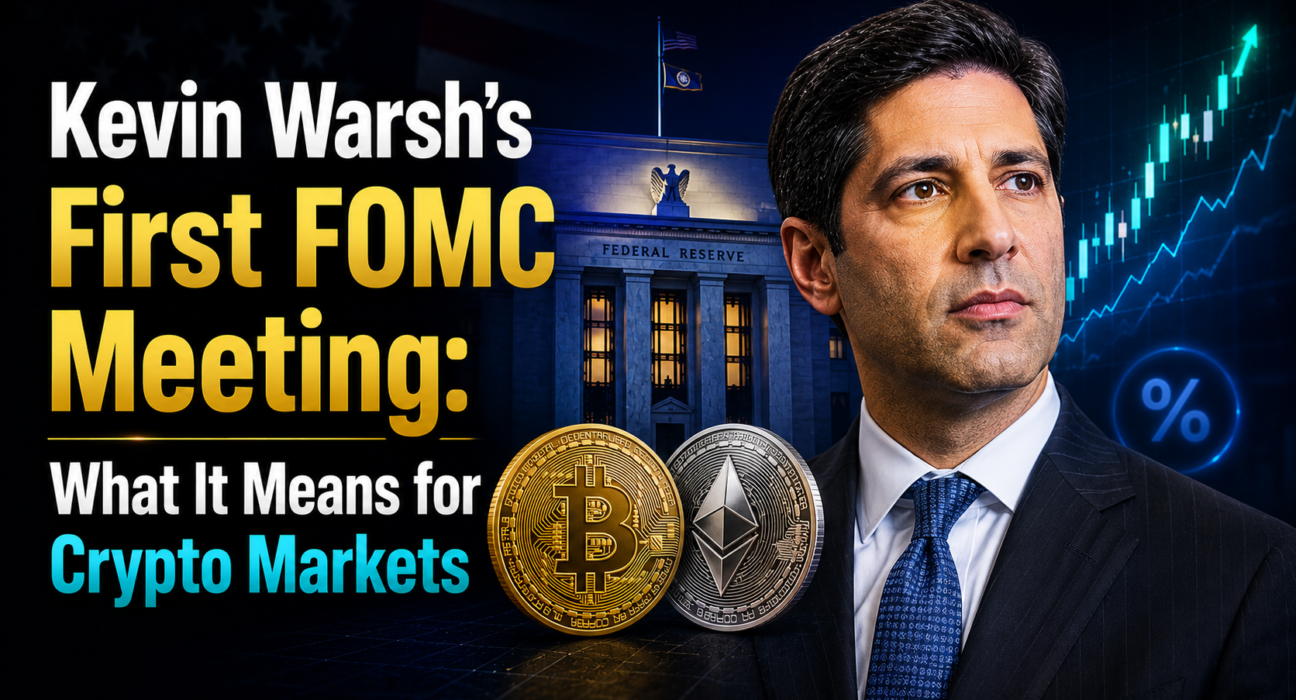
Kevin Warsh was sworn in as the 17th chair of the Federal Reserve on May 22, 2026. His first meeting leading the Federal Open Market Committee took place over June 16 to 17, 2026, with the rate decision announced at 2:00 p.m. ET on Wednesday, followed by his debut press conference at 2:30 p.m. ET.
In the high-stakes world of crypto, Federal Reserve decisions are not just macro noise. They function as the ultimate liquidity dial, and Warsh’s inaugural meeting delivered a masterclass in exactly why that matters.
Going into the meeting, the rate call itself was almost a non-event. Economists overwhelmingly expected the Federal Reserve to leave its benchmark rate unchanged, and that is exactly what happened. The genuine story of the meeting was everything that came alongside the unchanged rate: a dramatically rewritten communication style, a historic refusal to participate in the Fed’s own forecasting tool, and a dot plot that flipped from projecting cuts to projecting hikes within a single quarter.
The Rate Decision: No Surprise on the Surface
The Federal Open Market Committee voted unanimously, 12-0, to keep its benchmark overnight borrowing rate anchored in a range of 3.50% to 3.75%, holding steady for a seventh consecutive meeting. The federal funds rate has held in this range since the central bank’s last cut, which occurred in December 2025.
| Meeting Detail | Outcome |
|---|---|
| Vote | 12-0, unanimous to hold |
| Rate range | 3.50% to 3.75% (unchanged) |
| Consecutive holds | Seventh straight meeting |
| Last rate cut | December 2025 |
| Market expectation | Hold was widely anticipated |
| Press conference | 2:30 p.m. ET, June 17, 2026 |
This part of the announcement matched what virtually every economist surveyed by FactSet and other outlets had predicted heading into the meeting. If the story had ended with the rate decision itself, this would have been a forgettable, fully priced-in event for crypto markets. It did not end there.
The Real Shock: Warsh Abandons Forward Guidance
The post-meeting statement released Wednesday contained around 130 words, down from figures above 300 recorded in recent meetings. This was not a minor editing choice. It was a deliberate, structural break from over a decade of Fed communication practice.
Warsh has specifically criticized how the Fed communicates, arguing that it leads to policy errors and entangles the central bank in markets. During his press conference, Warsh directly acknowledged the change. “It’s a bit shorter, a bit simpler and it dispenses with some older language,” he said. “That statement just gives you the facts, as best we can judge it.”
The statement offered just a brief summary of economic conditions followed by a vow to control inflation, stating that economic activity is expanding at a solid pace despite elevated uncertainty that owes, in part, to the conflict in the Middle East. Critically, the post-meeting statement removed prior language seen as a nod toward an easing slant in the future, taking what one analyst described as a hatchet to the rest of the usual forward-looking guidance entirely.
“Warsh’s first FOMC statement left the clear impression that there is a new chair in town,” said Ian Lyngen, head of U.S. rates strategy at BMO. “The statement was significantly shortened, eliminating the forward guidance,” he said.
“What Kevin Warsh is trying to do with this statement is not use the statement to give forward guidance, and I think he did a pretty good job with that,” said David Wessel, senior fellow at Brookings, on CNBC’s Power Lunch.
Why This Matters Specifically for Crypto Markets
Markets, including crypto markets, had spent years calibrating their expectations partly around the specific language embedded in Fed statements, parsing word choices and phrase removals for clues about future policy direction. By stripping the statement down to just the facts as best the committee can judge them, Warsh removed a dovish language anchor that markets had been counting on, replacing a familiar, gradually-evolving signal with abrupt silence on forward direction.
Warsh Refuses to Submit a Dot Plot
This is the single most unusual and historically unprecedented action from the entire meeting. Warsh did not share his views in the closely watched dot plot grid, becoming the first Fed Chair to refuse to submit personal interest rate projections in the tool’s history.
Warsh bluntly stated that forward guidance is not suited to the current economic environment, explicitly declaring, “I cannot give you any forward guidance on what we are going to do.” Warsh declined to say whether he has spoken with President Trump since being sworn in as Fed Chair, though he confirmed he has met with Treasury Secretary Scott Bessent three times so far, describing such meetings as a long-running practice between the two roles.
Most notably, Warsh directly broke from the Fed’s traditional 14-year communication mechanism by abruptly abolishing forward guidance without prior warning and leading what amounted to a boycott of the dot plot from his own position at the head of the table.
For markets accustomed to scrutinizing every single dot on the Fed’s projection grid for clues about the path of policy, having the chair himself simply opt out sent its own distinct signal: genuine, deliberate uncertainty about the path ahead, communicated through silence rather than guidance.
The Dot Plot Shock: From Zero Hikes to Nine Officials Projecting One
While Warsh himself declined to submit a projection, the other 18 FOMC participants did not, and their collective shift is what actually moved markets.
| Dot Plot Metric | March 2026 Projection | June 2026 Projection |
|---|---|---|
| Officials projecting a 2026 rate hike | Zero | 9 of 18 |
| Officials projecting two hikes in 2026 | Zero | 6 of 18 |
| Median year-end 2026 rate projection | 3.4% | 3.8% |
| PCE inflation forecast (year-end 2026) | 2.7% | 3.6% |
| Expectation for any 2026 rate cut | Previously anticipated | Collapsed to zero |
Among the 19 committee members, 9 officials now expect at least one more rate hike by the end of 2026, a stark contrast to the projections from March of this year, when no officials anticipated any rate hikes at all. Six of 18 Fed officials now project two rate hikes this year. In March it was zero.
This is widely described as a complete hawkish reversal from the March dot plot, which had projected cuts. The Fed’s own models, through the revised PCE inflation forecast jumping to 3.6%, confirm that inflation is running considerably hotter than the committee had previously expected just one quarter earlier.
A parallel survey of 32 former Fed officials and staff, conducted between June 5 and 12 by Jon Hilsenrath at Duke University ahead of this meeting, found 17 of 32 believed an interest rate hike would be appropriate in 2026, with 14 saying no increase was warranted and one supporting a cut, reinforcing that Warsh’s hawkish tilt reflects a broader institutional reading among Fed-adjacent economists, not simply one new chair’s personal preference.
Why Inflation Forced This Hawkish Turn
The dot plot shift did not happen in a vacuum. Consumer prices rose 4.2% in May from a year ago, the biggest annual increase since April 2023, driven mostly by costlier gas tied to the Iran war, which began February 28, 2026.
The revised inflation outlook reflects mounting concerns about persistent price pressures, particularly from energy markets. Recent inflation data showed US consumer prices rising at their fastest pace in three years, prompting the Fed to maintain a cautious stance despite evidence of moderating economic growth elsewhere in the economy.
A full half of the committee members favor a hike as soon as 2026, citing a firm labor market alongside inflation sitting at a three-year high. Warsh himself repeatedly stressed the Fed’s commitment to price stability throughout his press conference, a signal he may not deliver the rapid cuts that many had expected from a chair nominated under President Trump. He made clear that getting inflation back to the Fed’s 2% goal remains the explicit priority, and that he wants to make that happen regardless of political pressure for faster easing.
This connects directly to VBD’s earlier coverage of the broader macro picture: the same US-Iran conflict that VBD identified as a major driver of the June 2026 crypto crash is now also the specific mechanism feeding the inflation data that just hardened the Fed’s hawkish stance for the remainder of the year.
How Crypto Markets Reacted in Real Time
Bitcoin entered the meeting holding near $65,000, with an intraday range of $65,653 to $67,230, having recovered strongly from the prior week’s selloff that had taken it below $60,000.
The initial reaction to the rate hold itself was muted, since the hold was fully expected. The real move came once the dot plot and Warsh’s press conference commentary registered with traders.
| Reaction Timeline | Bitcoin Price / Market Response |
|---|---|
| Pre-meeting (June 17, morning) | Holding near $65,000, range $65,653 to $67,230 |
| Immediately post-statement | Muted initial reaction (rate hold was priced in) |
| Post dot plot release | Bitcoin began sliding as hawkish shift registered |
| Post press conference | Bitcoin dropped toward $64,000 to $65,400 range |
| Following day (June 18) | Bitcoin fell nearly 3%, briefly below $64,000 |
| September hike odds (pre-meeting) | Approximately 30% |
| September hike odds (post-meeting) | Approximately 70% (with a 20% chance of a double hike) |
| December hike odds | Approximately 88% chance of at least one hike |
| 2-year Treasury yield | Jumped more than 16 basis points to 4.22% |
Despite no surprise on rates, Bitcoin dropped around 1% to the $65,400 range as investors reacted to the Fed’s more hawkish outlook, with the decline continuing into the following session. By Thursday, June 18, the Fed’s unexpected hawkish shift, marked by the abandonment of forward guidance and the more aggressive dot plot, triggered a broader sell-off across global risk assets, with Bitcoin falling nearly 3% below $64,000 as rising Treasury yields and a stronger dollar tightened liquidity conditions.
Despite the immediate decline, Bitcoin’s reaction was relatively muted compared to previous hawkish Fed surprises, a detail that several analysts pointed to as evidence that crypto markets had already substantially priced in macro caution heading into an event widely flagged in advance as historically significant.
US stocks fell alongside crypto: the S&P 500 dropped about 0.5%, or 36 points, the Nasdaq fell nearly 1%, or 241 points, and the Dow Jones Industrial Average declined approximately 66 points initially before falling a further 507 points as the full hawkish picture solidified, with the VIX volatility index also moving higher.
Strategy’s stock (MSTR) fell 5% in the aftermath, and STRC, a related instrument, made a new low at $89, illustrating how the hawkish surprise rippled beyond spot crypto prices into the broader ecosystem of Bitcoin-adjacent equities that VBD has covered throughout the June 2026 crash period.
Bitcoin’s Key Technical Levels After the Meeting
With the dot plot eliminating any expectation of 2026 cuts and projecting hikes instead, several analysts immediately reassessed Bitcoin’s near-term technical picture.
From technical charts and on-chain data, $60,000 to $62,000 is currently a highly critical high-volume turnover zone and a key line of defense for leveraged long positions. If Bitcoin can stabilize effectively in this zone, the path toward recovering the $70,000 resistance level remains intact, but stability here is considered essential first.
The $64,350 level, which had held as support prior to the FOMC decision, flipped to become the immediate resistance level that Bitcoin needed to reclaim in the aftermath. Meanwhile, the broader recovery from the $59,130 May low that had been building through early June was not entirely reversed by the Fed decision, but analysts characterized it as having hit a significant speed bump rather than being fully derailed.
One specific near-term catalyst that several analysts flagged as a potential offset to the hawkish Fed signal: a formal US-Iran peace signing reportedly scheduled around June 19 remains the one identifiable near-term macro tailwind, since any associated decline in oil prices toward $75 would be disinflationary, representing the one data point that could meaningfully push back against the Fed’s newly hardened hawkish dot plot in the weeks ahead.
The Warsh Paradox: Crypto-Literate but Genuinely Hawkish
This is a tension VBD has tracked since Warsh’s nomination and confirmation, and his first FOMC meeting confirmed both sides of it simultaneously.
Kevin Warsh is not a typical Fed chair, and that adds genuine uncertainty in both directions for crypto markets specifically. On one hand, he is widely described as the most crypto-literate chair in Federal Reserve history, with a documented openness to digital assets that the market has generally read as a long-term structural positive for the asset class, a point VBD detailed extensively in our earlier coverage of his expected approach to crypto policy.
On the other hand, he is, by his own conduct in this first meeting, a genuine monetary hawk who inherited a central bank facing inflation that re-accelerated to 4.2% in May, driven substantially by the energy shock from the ongoing Iran conflict. His repeated emphasis on price stability, his removal of the easing bias from the Fed’s statement, and his refusal to even submit a dot suggesting he might be sympathetic to near-term cuts, all point toward a chair who is prioritizing inflation control over the kind of rapid easing that would typically be most supportive of Bitcoin and broader risk assets in the near term.
The market’s challenge going forward is that these two characteristics, crypto literacy and monetary hawkishness, are not contradictory. A chair can simultaneously hold a favorable long-term structural view of digital assets while pursuing a genuinely tight near-term monetary policy in response to the inflation data actually in front of him. Investors hoping that Warsh’s personal crypto sympathies would translate into near-term dovish policy accommodation received a clear answer in this first meeting: that is not how he intends to govern, at least not while inflation sits at a three-year high.
What Comes Next: The Five Task Forces and the Path Ahead
Beyond the rate decision and the dot plot, Warsh announced he would form five task forces to review and overhaul major Federal Reserve operations, signaling an intent toward broader structural change at the central bank that extends well beyond any single meeting’s rate decision.
This combination, a chair actively reshaping the institution’s internal operations and communication practices while simultaneously presiding over a hawkish pivot on rates, suggests that markets should expect continued unpredictability in form even as the substance of policy (a clear current bias toward higher-for-longer rates) has become considerably clearer following this meeting.
The next several weeks carry two clear watch points for crypto traders specifically. First, the September FOMC meeting, where rate-hike odds have already repriced from roughly 30% to nearly 70% in the 24 hours following Warsh’s debut, representing the next major scheduled test of whether this hawkish dot plot translates into actual policy action. Second, any developments on the US-Iran conflict, given that a resolution lowering oil prices represents the most direct disinflationary lever available to push back against the Fed’s newly hardened stance before that September meeting arrives.
What This Means for Indian Crypto Investors
For VBD’s Indian readers, Warsh’s first FOMC meeting reinforces and extends several themes already covered across our recent macro analysis.
This directly confirms the thesis from VBD’s Dollar Index Breakout coverage. The greenback’s recent strength, and the DXY’s breakout above the key 100.60 level covered in our dedicated analysis, is now even more directly explained: the 2-year Treasury yield jumping over 16 basis points to 4.22% and rate-hike odds collapsing any 2026 cut expectations to zero are precisely the kind of hawkish monetary signals that drive sustained dollar strength, with the corresponding pressure on Bitcoin’s dollar-denominated price that VBD’s correlation analysis described in detail.
Bitcoin’s technical levels deserve close monitoring. The $60,000 to $62,000 zone identified as critical support, and the $64,350 level that flipped from support to resistance, are concrete, specific levels Indian investors can track over the coming weeks as signals of whether the broader recovery attempt from the May low survives this hawkish surprise or gives way to renewed downside pressure.
The September FOMC meeting is now a key date to watch. With hike odds for that meeting nearly tripling in a single day following Warsh’s press conference, Indian crypto investors managing positions with a multi-month horizon should treat that meeting date as a significant calendar risk event, alongside any near-term developments on the US-Iran conflict that could offset the current hawkish trajectory.
Tax treatment remains unaffected by any of these macro developments. Whatever direction Bitcoin moves in response to Fed policy over the coming weeks, India’s 30% flat tax plus 4% cess on realised VDA gains, with no loss offset permitted, continues to apply exactly as detailed in VBD’s Bitcoin Tax India guide, regardless of whether that movement was driven by Fed policy, dollar strength, or any other macro catalyst.
Frequently Asked Questions
1. What happened at Kevin Warsh’s first FOMC meeting?
Kevin Warsh chaired his first Federal Open Market Committee meeting on June 16 to 17, 2026. The Fed voted 12-0 to hold rates at 3.50% to 3.75%, as expected, but Warsh delivered several surprises: he abandoned forward guidance entirely, shrinking the post-meeting statement to just 130 words, and became the first Fed Chair in history to refuse to submit his own projection in the dot plot. The dot plot itself showed 9 of 18 officials now projecting at least one rate hike by year-end 2026, up from zero in March.
2. Did the Federal Reserve raise interest rates in June 2026?
No. The Federal Open Market Committee voted unanimously, 12-0, to hold the benchmark federal funds rate at 3.50% to 3.75%, marking the seventh consecutive meeting without a change. However, the accompanying dot plot signaled a significant hawkish shift, with a majority of officials now projecting at least one rate hike before the end of 2026, a complete reversal from the no-hike projections issued in March.
3. Why did Bitcoin fall after the Fed held rates steady?
Bitcoin fell because the rate hold itself was fully expected and already priced in, but the Fed’s dot plot delivered a genuine hawkish shock: 9 of 18 officials now project at least one 2026 rate hike, up from zero in March, and the Fed raised its inflation forecast to 3.6% from 2.7%. This hawkish repricing pushed Treasury yields and the dollar higher, tightening financial conditions and pressuring risk assets including Bitcoin, which fell from near $65,000 to briefly below $64,000.
4. What is forward guidance and why did Warsh remove it?
Forward guidance refers to the language the Federal Reserve traditionally includes in its post-meeting statements to signal its likely future policy direction. Warsh removed this language entirely in his first meeting, shrinking the statement to just 130 words and stating that the statement should give the facts as best the committee can judge them, rather than offering guidance on future moves. Warsh has previously criticized this kind of communication for entangling the Fed too deeply in market expectations and potentially leading to policy errors.
5. What is the Fed dot plot and why is it significant that Warsh did not submit one?
The dot plot is a chart showing each individual Federal Reserve official’s projection for where interest rates will be at various points in the future, traditionally used by markets to gauge the likely path of monetary policy. Kevin Warsh became the first Fed Chair in the tool’s history to decline to submit his own projection, stating he could not give forward guidance on future policy given current conditions, a move widely interpreted as reinforcing the broader communication overhaul he is pursuing at the central bank.
6. What key Bitcoin price levels are important after this Fed meeting?
Analysts identified $60,000 to $62,000 as a critical high-volume support zone and key line of defense for leveraged long positions following the hawkish Fed surprise. The $64,350 level, which had served as support before the meeting, flipped to become the immediate resistance level Bitcoin needed to reclaim afterward. Stability in the $60,000 to $62,000 zone is considered necessary before any recovery attempt toward the $70,000 resistance level can resume.
7. Is Kevin Warsh good or bad for crypto markets?
The answer is genuinely mixed. Warsh is widely regarded as the most crypto-literate Fed Chair in history, with documented openness to digital assets, which markets generally view as a favorable long-term structural signal. However, his first FOMC meeting demonstrated that he is also a genuine monetary hawk prioritizing inflation control, given that consumer prices rose 4.2% in May, the fastest pace in three years. His crypto sympathies have not translated into near-term dovish policy, and his hawkish dot plot and removal of forward guidance created immediate downward pressure on Bitcoin.
8. What should crypto investors watch next after this Fed meeting?
The September FOMC meeting is now a key date, with rate-hike odds for that meeting repricing from roughly 30% to nearly 70% within 24 hours of Warsh’s press conference. Additionally, any resolution to the US-Iran conflict, including a reported peace signing around June 19, represents the clearest near-term catalyst that could push oil prices lower and provide a disinflationary offset to the Fed’s newly hawkish stance before the next meeting.
Conclusion
Kevin Warsh’s first FOMC meeting confirmed what VBD’s earlier coverage had anticipated: a chair whose personal crypto sympathies do not override his commitment to fighting inflation through tight monetary policy when the data demands it. The rate hold itself surprised no one. Everything else, the 130-word statement, the historic refusal to submit a dot plot, and the dramatic flip from zero projected hikes in March to nine officials projecting at least one hike in June, surprised markets considerably, and Bitcoin’s slide from near $65,000 toward $64,000 and briefly below reflected that genuine repricing of the path ahead.
The connection to VBD’s broader recent coverage is direct and immediate: this hawkish surprise is the same force driving the Dollar Index breakout covered in our dedicated analysis, and it extends the same macro headwinds, a hawkish Fed, geopolitical conflict in the Middle East, and tightening financial conditions, that VBD identified as central drivers of the broader June 2026 crypto market weakness.
The path forward hinges on two clear variables: whether the September FOMC meeting, now pricing nearly 70% odds of a hike, actually delivers one, and whether any resolution to the US-Iran conflict provides the disinflationary relief that could give Warsh room to soften his stance before then. Until either of those resolves, the $60,000 to $62,000 zone remains the level every Bitcoin holder, in India and globally, should be watching closely.
At Vox Buzz Daily (VBD), we track every Fed decision, macro signal, and ETF flow shaping Bitcoin’s price. Follow us on Twitter (@voxbuzzdaily), Instagram, and LinkedIn for daily updates as this story develops through the September meeting.