Quick Updates
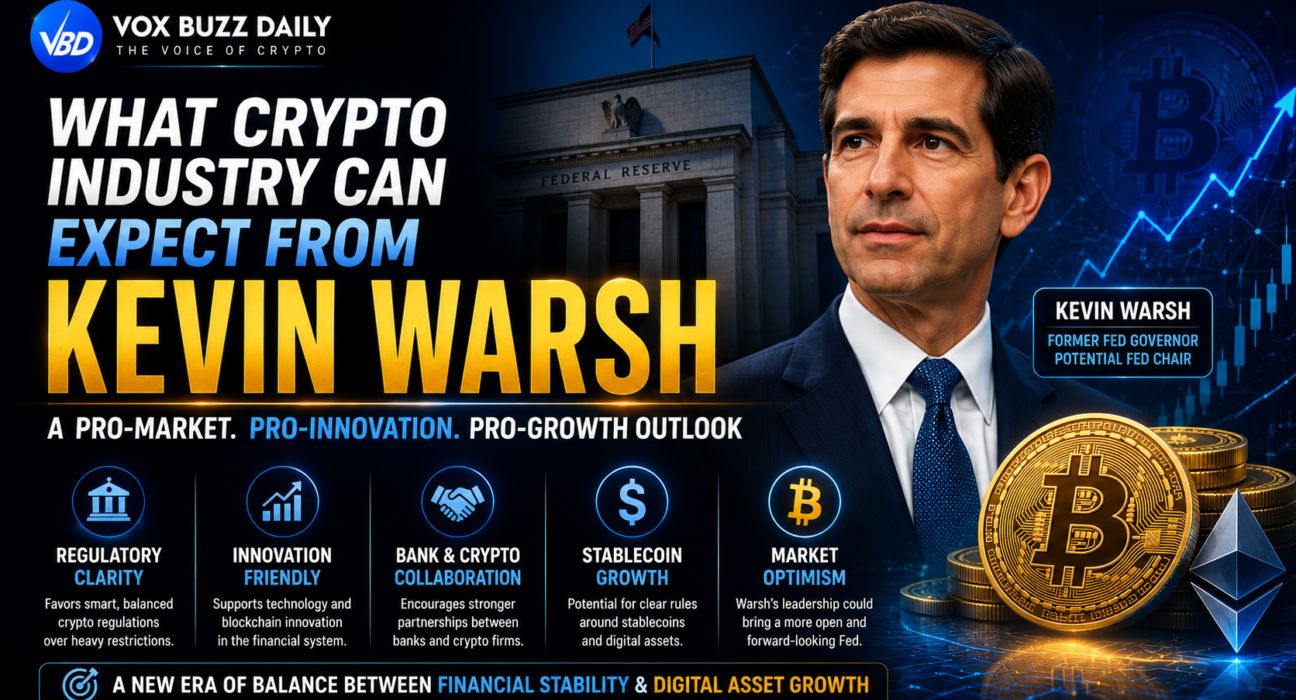
Kevin Warsh was confirmed as the 17th Chair of the Federal Reserve on May 13, 2026, by a 54–45 Senate vote, officially succeeding Jerome Powell on May 15, 2026. He is the first Fed Chair in history to disclose personal crypto holdings – between $131 million and $209 million across 30+ digital assets. While his crypto-friendly background is bullish for long-term regulation and legitimacy, his hawkish monetary policy stance (higher-for-longer rates, quantitative tightening) is a near-term headwind for Bitcoin and risk assets. The crypto industry should expect: better regulatory clarity, slower rate cuts, institutional legitimization – and significant short-term volatility.
Who is Kevin Warsh?
Kevin Warsh is an attorney, financier, and now the 17th Chair of the United States Federal Reserve — the most powerful central banking role in the world.
He was officially confirmed by the US Senate on May 13, 2026, by a 54–45 vote, and succeeded Jerome Powell on May 15, 2026, when Powell’s term as Chair expired.
Here is his background in brief:
| Detail | Info |
|---|---|
| Full Name | Kevin Maxwell Warsh |
| Born | 1970 |
| Education | Stanford Law School |
| Previous Fed Role | Governor, Federal Reserve Board (2006–2011) |
| Post-Fed Career | Visiting Fellow, Stanford Hoover Institution |
| Nominated by | President Donald Trump (January 2026) |
| Confirmed | May 13, 2026 — Senate 54–45 |
| Took Office | May 15, 2026 |
| Net Worth Disclosed | $131 million – $209 million |
| Crypto Holdings | $131M–$209M across 30+ digital assets |
Warsh is known as a “monetary hawk” — historically favouring tighter monetary policy, a smaller Fed balance sheet, and central bank independence from political pressure. He has publicly stated he will exercise his own policy discretion rather than following White House directives, even as President Trump publicly called for rate cuts.
What makes Warsh uniquely significant for the crypto industry is not just his policy outlook — it is his unprecedented personal exposure to the digital asset sector, making him the first Fed Chair in the institution’s 113-year history to arrive with disclosed crypto investments.
Warsh’s Crypto Holdings- What He Owns
This is where the story gets genuinely historic. Warsh’s April 2026 financial disclosure revealed a crypto portfolio valued between $131 million and $209 million across more than 30 digital assets and crypto-related ventures.
Known crypto holdings disclosed include:
| Asset / Company | Type | Notes |
|---|---|---|
| Bitcoin (BTC) | Cryptocurrency | Direct holdings disclosed |
| Solana (SOL) | Cryptocurrency | Direct holdings |
| dYdX | DeFi Protocol | Holdings disclosed |
| Compound | DeFi Protocol | Holdings disclosed |
| Bitwise Asset Management | Crypto Index Fund | Early investor |
| Polymarket | Prediction Market | Holdings disclosed; pledged to divest |
| Flashnet | Bitcoin Lightning Startup | Invested |
| Basis (Algorithmic Stablecoin) | Stablecoin Project | Past investment |
| Electric Capital | Crypto/Blockchain VC | Served as adviser |
Under Federal Reserve ethics rules, Warsh was required to divest all personal crypto holdings by May 15, 2026 — the day he took office. This means he no longer personally holds these assets as Fed Chair.
However, his deep familiarity with these protocols, the founders behind them, and the mechanics of DeFi, stablecoins, and crypto infrastructure make him — by a wide margin — the most crypto-literate Fed Chair in history.
In January 2021, Warsh stated on CNBC: “Bitcoin is the new gold for anyone under 40” — a comment that coincided with Bitcoin crossing $30,000 for the first time. That quote has taken on new significance now that he leads the world’s most powerful central bank.
How Markets Reacted to Warsh’s Appointment
The market’s reaction to Warsh’s appointment has been counterintuitive – and instructive.
January 2026 — Nomination Announcement: When Trump officially named Warsh as his nominee to replace Powell, Bitcoin dropped 6% immediately. Markets were pricing in Warsh’s hawkish monetary reputation – not his crypto holdings. The “higher for longer” rates fear trumped the “crypto-friendly Fed Chair” optimism.
April 2026 — Confirmation Hearing: Bitcoin fell a further 14% cumulatively in early 2026 following the nomination and anticipation of the hearing. Macro concerns dominated.
May 13, 2026 — Senate Confirmation Vote: Bitcoin held near $79,500 in the hours immediately following the Senate’s 54–45 confirmation vote — showing little reaction. Markets had largely priced in the confirmation.
May 15–16, 2026 — Warsh Takes Office: Bitcoin slipped to around $74,190 on the weekend Warsh assumed the role — its lowest level in more than a month. The 2-year US Treasury yield climbed to 4.14% — its highest since February 2025 — as traders priced in higher-for-longer rates under Warsh. CME FedWatch data showed markets pricing virtually no rate cuts for most of 2026, with a possible 25 basis point rate hike at the December meeting becoming the base case.
The takeaway: The market is treating Warsh as a hawkish macro risk first and a crypto-friendly regulator second. Short-term, his monetary policy stance is the dominant force on Bitcoin’s price. Long-term, his regulatory posture could be transformative.
What Warsh’s Monetary Policy Means for Bitcoin
This is the most important thing for crypto investors to understand about Warsh:
His crypto holdings are irrelevant to monetary policy. His rate decisions are everything.
Bitcoin in 2026 has become a macro asset. It trades in the same liquidity conversation as AI stocks, US Treasuries, oil, and the dollar. When rates rise and real yields increase, risk assets including Bitcoin face headwinds — regardless of how crypto-friendly the Fed Chair’s personal views are.
Warsh inherits the Fed with:
- Inflation running at 3.3–3.8% — above the Fed’s 2% target, driven partly by Middle Eastern geopolitical energy shocks
- Federal funds rate at 3.50–3.75% — already elevated
- Fed balance sheet at $6.7 trillion — which Warsh has historically argued must be reduced through Quantitative Tightening (QT)
- Political pressure from Trump to cut rates — which Warsh has publicly said he will resist if inflation demands otherwise
Warsh’s known monetary philosophy from his 2006–2011 Governor term emphasises “monetary discipline” and a smaller Fed balance sheet. This means:
- Rate cuts are unlikely in H1 2026 — and even a rate hike in December 2026 has a ~67% probability priced in by markets
- Quantitative Tightening (QT) continues — reducing liquidity in the financial system, which historically weighs on risk assets
- Bitcoin’s “digital gold” narrative gets tested — if rates stay high and real yields remain positive, the opportunity cost of holding non-yielding Bitcoin increases
The irony is real: the most crypto-literate Fed Chair in history may preside over a macro environment that is one of the most challenging for crypto in recent years.
The Interest Rate Outlook Under Warsh
Here is what CME FedWatch data and market pricing show as of May 2026:
| Meeting | Rate Action | Probability |
|---|---|---|
| June 2026 | Hold (no change) | ~96.5% |
| July 2026 | Hike of 25 bps | ~17% |
| September 2026 | Hold or Hike | Mixed |
| December 2026 | Hike of 25 bps | ~67% |
What this means for Bitcoin:
- Lower rates → more liquidity → better environment for risk assets like Bitcoin
- Higher rates → tighter liquidity → Bitcoin faces headwinds
If Warsh cuts rates in H2 2026 (unlikely based on current pricing), Bitcoin could see a sharp rally. If rates stay flat or rise, Bitcoin’s macro tailwind remains absent, and price recovery depends on ETF flows, CLARITY Act passage, and crypto-specific catalysts rather than broad liquidity expansion.
The one scenario that could force Warsh’s hand on cuts: a significant macro shock, recession, or financial stability event that outweighs inflation concerns. In that scenario, Bitcoin could actually benefit as a risk-off “digital gold” asset — a narrative Warsh himself has endorsed.
Regulatory Shift: A More Crypto-Friendly Fed?
Beyond monetary policy, the Fed plays a significant role in crypto regulation — particularly for banks, stablecoins, and institutional participation. This is where Warsh’s crypto background becomes genuinely bullish.
1. Bank Access to Crypto — Likely to Improve
Under Powell, the Fed maintained a cautious approach to banks engaging with crypto. Warsh’s background — including investment in Bitwise Asset Management and advisory roles at crypto VC firm Electric Capital — signals a more pragmatic posture toward banks holding, custody, and clearing digital assets.
2. Stablecoin Framework
Warsh previously invested in Basis, an algorithmic stablecoin project. While Basis failed, his familiarity with stablecoin mechanics positions him to engage constructively with stablecoin regulation — a sector that is simultaneously being shaped by the GENIUS Act (stablecoin legislation) moving through Congress.
3. CBDC — Collaborative, Not Adversarial
Unlike some previous Fed officials who dismissed crypto entirely, Warsh is expected to take a collaborative approach to Central Bank Digital Currency (CBDC) exploration — working with the private crypto sector rather than positioning a CBDC as a competitor to existing digital assets.
4. Institutional Adoption — The Conflict-of-Interest Question
Democrats raised pointed conflict-of-interest questions during Warsh’s Senate hearing: how can someone who held $200M+ in crypto regulate the sector impartially? Warsh’s answer was divestment — and recusal where necessary. But even with divestment, his deep personal network in the crypto industry (Bitwise, Electric Capital, dYdX founders) could meaningfully influence how the Fed engages with crypto infrastructure going forward.
The CLARITY Act — Warsh’s Role
The Digital Asset Market Clarity Act (CLARITY Act) — the most significant US crypto legislation ever — is simultaneously moving through the Senate. The Fed Chair does not vote on legislation, but influences it through:
- Formal testimony to Congress on digital asset regulation
- Fed guidance to banks on crypto engagement
- Financial stability reports that shape regulatory appetite
Warsh’s crypto fluency means he is unlikely to testify against crypto innovation the way previous Fed officials did. His presence in the role is expected to lower political resistance to the CLARITY Act from the Fed side — removing one institutional voice that previously added friction to pro-crypto legislation.
Citi analysts projected that CLARITY Act passage could trigger an additional $15 billion in Bitcoin ETF inflows and push BTC toward $143,000. A Warsh-led Fed that does not actively oppose the bill is a meaningful supporting factor in that scenario.
What Each Crypto Sector Can Expect
Bitcoin (BTC)
Short-term: Hawkish rates are a headwind. BTC is likely to remain range-bound in the $74,000–$85,000 zone until rate clarity improves or CLARITY Act passes.
Long-term: Warsh’s institutional legitimization of Bitcoin as an asset class — combined with the US Strategic Bitcoin Reserve and ETF demand — is structurally bullish. His “Bitcoin is the new gold for under-40s” comment reflects genuine understanding of BTC’s role as a store of value.
Ethereum (ETH)
Short-term: Similar rate headwinds as Bitcoin.
Long-term: CLARITY Act passage under a Warsh-era Fed creates the legal basis for ETH staking ETF products. Standard Chartered targets $7,500 ETH in 2026 contingent on CLARITY Act progress — Warsh’s Fed removes one obstacle.
DeFi
Potential positive: Warsh has personally invested in dYdX and Compound — two flagship DeFi protocols. He understands how decentralized lending and trading works from the inside. This is the first time a Fed Chair has hands-on familiarity with DeFi mechanics.
Concern: DeFi regulation remains complex — the CLARITY Act addresses some but not all DeFi regulatory questions. Warsh’s influence here is indirect and long-term.
Stablecoins
Key watch: The GENIUS Act (stablecoin legislation) is moving through Congress alongside the CLARITY Act. A Warsh-led Fed that engages constructively with stablecoin issuers — rather than treating them as threats — could accelerate the US stablecoin framework significantly.
Altcoins and Emerging Tokens
Mixed: If Warsh eases the Fed’s regulatory stance on crypto infrastructure projects, utility-based altcoins could benefit. However, rate headwinds and a risk-off environment hurt smaller, more speculative altcoins disproportionately compared to Bitcoin. In a higher-for-longer rate environment, capital tends to concentrate in BTC and ETH rather than altcoins.
Historical Warning: New Fed Chairs and Bitcoin
Before getting too optimistic, here is a sobering historical data point:
| Fed Chair | Took Office | Bitcoin Price Action After |
|---|---|---|
| Janet Yellen | February 2014 | Bitcoin plunged ~86% during her early tenure |
| Jerome Powell | February 2018 | Bitcoin fell ~74% in the year following his appointment |
| Kevin Warsh | May 2026 | Currently -38% from ATH; trend TBD |
The pattern is striking: changes in Fed leadership have historically preceded significant Bitcoin sell-offs — regardless of the Chair’s personal views on crypto.
Why? Because new Fed Chairs typically bring policy uncertainty. Markets reprice risk when they cannot accurately model the new Chair’s reaction function. This uncertainty itself creates selling pressure in volatile assets like Bitcoin.
Warsh’s case is complicated by the fact that:
- His hawkish rate stance is already known and partially priced in
- His crypto background provides a partial offset to the “uncertainty discount”
- Bitcoin is a structurally different asset in 2026 than in 2014 or 2018 — with $150B+ in ETFs and a US government reserve
Whether history repeats or rhymes differently this time remains to be seen.
The Bull Case for Crypto Under Warsh
The long-term bull case for crypto under Warsh is genuinely compelling:
1. Historic Legitimization A Fed Chair who personally invested $200M in crypto sends an unmistakeable signal to every institutional investor, sovereign wealth fund, and pension manager on the planet: digital assets are a legitimate asset class. This is the single most powerful legitimization event in crypto’s history.
2. Regulatory Collaboration vs. Antagonism The Powell Fed was characterised by regulatory caution and, in some cases, active friction with crypto innovation. A Warsh Fed — led by someone who has sat in board rooms with dYdX founders and Bitwise executives — is expected to be genuinely collaborative on defining the rules of the road.
3. The Inflation Narrative Benefits Bitcoin If Warsh’s hawkish policy fails to fully tame inflation (currently 3.3–3.8%), Bitcoin’s “digital gold” and inflation hedge narrative gets strengthened. A world where the Fed Chair cannot control inflation is a world where Bitcoin’s fixed-supply value proposition becomes increasingly attractive to institutional investors.
4. Rate Cuts Eventually Arrive CME data shows even the most hawkish 2026 scenario prices in rate stability, not indefinite hikes. When Warsh eventually pivots to easing — driven by a softening economy or labour market — the liquidity surge that historically follows is one of Bitcoin’s most powerful bull catalysts.
The Bear Case for Crypto Under Warsh
1. Higher-for-Longer is Bitcoin’s Biggest Near-Term Enemy Rising 2-year Treasury yields at 4.14%, with a December 2026 rate hike at 67% probability, means real yields stay positive. Positive real yields reduce the appeal of non-yielding assets like Bitcoin. This macro backdrop alone could keep BTC range-bound at $74,000–$85,000 for an extended period.
2. Quantitative Tightening Drains Liquidity Warsh has historically advocated for reducing the Fed’s $6.7 trillion balance sheet. QT removes dollars from the financial system, tightening liquidity conditions that have historically correlated with Bitcoin underperformance. A simultaneous QT + high rates environment is the worst macro scenario for crypto.
3. Conflict-of-Interest Scrutiny Could Backfire Warsh’s deep personal ties to the crypto industry could make him over-cautious in his crypto-related policy decisions, to avoid accusations of acting in his former industry’s interest. Regulators with industry backgrounds often go out of their way to appear tough on their former sector.
4. Historical Pattern Holds If the historical pattern of new Fed Chair → Bitcoin sell-off repeats, Bitcoin could test the $65,000–$70,000 range before finding a bottom. The macro repricing that accompanies policy uncertainty has repeatedly hit Bitcoin harder than other asset classes.
Frequently Asked Questions
1. Who is Kevin Warsh and why does he matter for crypto?
Kevin Warsh is the newly confirmed Chair of the US Federal Reserve as of May 15, 2026. He is the most powerful central banker in the world and the first Fed Chair in history to disclose personal crypto holdings — valued at $131M–$209M across 30+ digital assets including Bitcoin, Solana, dYdX, Compound, and Bitwise Asset Management. His monetary policy decisions and regulatory posture will significantly influence the global crypto market.
2. How much crypto does Kevin Warsh own?
Warsh’s April 2026 financial disclosure revealed crypto holdings valued between $131 million and $209 million across more than 30 digital assets and crypto-related ventures. However, he was required to divest all personal crypto holdings by May 15, 2026 — the day he took office as Fed Chair — under Federal Reserve ethics rules.
3. Is Kevin Warsh pro-Bitcoin?
Warsh has a nuanced, pragmatic view on Bitcoin. In January 2021, he stated publicly that “Bitcoin is the new gold for anyone under 40.” He has invested in Bitcoin, Solana, and multiple DeFi protocols. However, he is not a crypto evangelist — he is skeptical of Bitcoin’s role as traditional money and focuses more on its store-of-value and institutional investment case.
4. Will Warsh cut interest rates in 2026?
Unlikely in the near term. CME FedWatch data shows markets pricing virtually no rate cuts for most of 2026, with a possible 25 basis point rate hike at the December 2026 meeting at approximately 67% probability. Warsh has publicly stated he will exercise independent monetary policy discretion — meaning he will not cut rates simply because Trump wants him to, unless economic conditions justify it.
5. How will Warsh’s Fed affect Bitcoin’s price?
In the short term, Warsh’s hawkish monetary stance — higher-for-longer rates, quantitative tightening, and a stronger US dollar — is a headwind for Bitcoin. In the longer term, his legitimization of crypto as an asset class, potential support for the CLARITY Act, and more collaborative regulatory stance toward banks and institutions engaging with digital assets are structurally bullish for Bitcoin.
6. What is the CLARITY Act and how does Warsh affect it?
The CLARITY Act is landmark US crypto legislation that would formally classify digital assets under a clear regulatory framework, unlocking institutional and pension fund capital for crypto. While the Fed Chair does not vote on legislation, Warsh’s crypto-fluent testimony to Congress and Fed guidance to banks are expected to reduce institutional resistance to the bill — a meaningful indirect catalyst for its passage.
7. What happened to Bitcoin when Warsh was confirmed?
Bitcoin held near $79,500 immediately following the May 13 Senate confirmation vote. By the weekend of May 16–17, when Warsh officially took office, Bitcoin slipped to approximately $74,190 — its lowest level in over a month — as markets priced in higher-for-longer rates. The 2-year Treasury yield simultaneously rose to 4.14%, its highest level since February 2025.
8. What crypto projects was Warsh personally invested in?
Based on his April 2026 financial disclosures, Warsh held stakes in Bitcoin, Solana, dYdX, Compound, Polymarket, Flashnet (Bitcoin Lightning startup), Basis (algorithmic stablecoin), and Bitwise Asset Management. He also served as an adviser to Electric Capital, a crypto and blockchain-focused venture capital firm. All holdings were divested before he took office.
Conclusion
Kevin Warsh’s arrival as Federal Reserve Chair on May 15, 2026, is the most consequential development for the crypto industry’s long-term institutional trajectory since the January 2024 Bitcoin ETF approval.
For the first time in the Fed’s 113-year history, the world’s most powerful central banker arrived at the role with a nine-figure personal portfolio in digital assets — Bitcoin, Solana, DeFi protocols, crypto venture funds. He understands the technology, the mechanics, and the people building it from the inside.
But the crypto market’s immediate reaction – Bitcoin sliding to $74,190 as he took office – reflects a harder truth: monetary policy trumps personal conviction. A crypto-friendly Fed Chair running a hawkish monetary regime is still a hawkish monetary regime. Higher rates, quantitative tightening, and positive real yields are the dominant near-term forces on Bitcoin’s price — not who sits in the Fed Chair’s seat.
The long game, however, is different. A Warsh-led Fed that engages collaboratively with stablecoin legislation, supports CLARITY Act progress, and opens doors for institutional bank participation in crypto is a multi-year structural tailwind of enormous magnitude.
For the crypto industry, the Warsh era is likely to be painful in the short term and transformative in the long term. Navigate both.
At Vox Buzz Daily (VBD), we track every Fed policy update, rate decision, and regulatory development that impacts the crypto market. Follow us on Twitter (@voxbuzzdaily), Instagram, and LinkedIn for real-time coverage.